
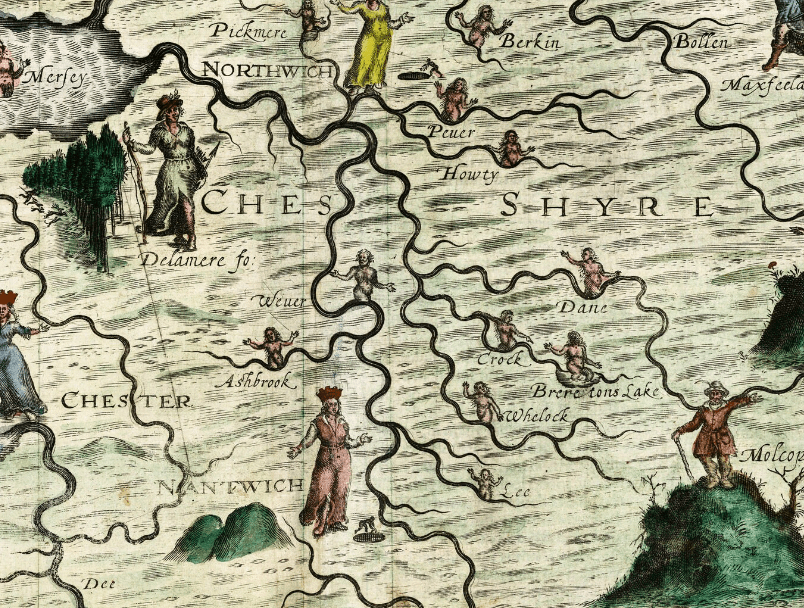
Ranulphus was a commoner during the time in which the third son of William the Conqueror, King William II (Rufus), ruled England between 1087 – 1100. Also known as “Rufus the Red”, Rufus was known as a tyrannical ruler who suffered many revolts by his Barons very early on in his reign.
The fable states that the King went hunting in New Forest or Vale Royal one day and became separated from his companions and attendants. Becoming lost and wandering aimlessly throughout the forest and glades, he continued through the eve of night and came upon a light beaming from a forest cabin. As he approached the cabin, he soon became discovered by Ranulphus. Without divulging his true identity, the King mentioned that he was lost. The forester, knowing it was foolhardy for him to continue, noted the traveler’s weary state and extended a warm meal and a secure night’s shelter instead.
Ranulphus and his wife slaughtered a goat and provided a fresh meal for their guest. With a warm hearth and couch to sleep, the King slumbered soundly until the next morning, where he partook in another hearty meal provided by his hosts.
Upon his departure, the King came to discover that he was not in fact lost, but had only been wandering within his own kingdom’s lea.
He was so delighted with the forester’s hospitality that he bestowed the whole of that portion of his domain, known as the King’s Lea, upon his host Ranulphus the Forester and made him a Baron. Ranulphus proudly took the name of the land King’s lea, ‘Kyngesliegh’.
From then on, he became known as Sir Ranulphus de Kyngesliegh. Later the family crest contained a Baron’s Crown surmounted by a goat’s head.
Ranulphus de Mesnil Warin
Ranulphus de Mesnil Warin was one of the thirty-two persons to whom William the Conqueror gave the most part of Cheshire, and had given him fifteen lordships there, among which was Peure, now called Over Peover, and which was the seat of the family for many generations.
Bestowing the name Ranulphus upon their children, or any close variation of, would have been a familiar practice amongst Cheshire commoners, as a way to pay homage to their lordship, Ranulphus de Mesnil Warin.
In my next installment, I will delve into questions that David himself was trying to solve.
© 2019 – 2025, Anne-Slanders.com. All Rights Reserved

 Anne Slanders
Leave a comment